TIC Data Shows an Abenomics Effect Alongside Massive Foreign Selling

The Treasury International Capital (TIC) report this morning showed that foreigners sold a record amount of U.S. Treasuries in April, and by a large margin:

Continue reading

Posted in Uncategorized | Tagged , , , | Comments Off on TIC Data Shows an Abenomics Effect Alongside Massive Foreign Selling

A 22 Article and Blog Post Guide to the NSA’s Surveillance Program

In between this initial description of the government’s Internet surveillance program (PRISM) and this collection of pics and musings of whistleblower Edward Snowden’s girlfriend that was passed around today, I’ve read quite a lot of coverage. And I was glad to see Bloomberg’s Clive Crook weigh in last night.

Why Crook?

Because I found in many years working overseas that foreigners often have the most interesting perspectives on America’s politics, laws and government. Crook is a Brit but reports in his latest commentary that he hopes to gain American citizenship. As expected, he has some provocative things to say and not just about PRISM but also our legal system generally. Here’s an excerpt that I especially liked:

Continue reading

Posted in Uncategorized | Tagged , , , , , | Comments Off on A 22 Article and Blog Post Guide to the NSA’s Surveillance Program

Testing Krugman’s Debt Reduction Strategy (And Finding It Fails)

Nike recently published a series of ads declaring “winning takes care of everything,” in reference to Tiger Woods’s recapture of the world #1 golfer ranking. The slogan went over with certain critics like an illegal ball drop.

Many economists insist that “economic growth takes care of everything,” and the related debate is no less contentious than the Nike ad kerfuffle. Listening to some pundits, you would think there’s one group that appreciates economic growth while everyone else wants to see the economy crumble. It seems to me, though, that growth is just like winning – there’s no such thing as an anti-winning camp, nor is there an anti-growth camp.

More fairly, much of the growth debate boils down to those who think mostly about long-run sustainable growth and those who advocate damn the torpedoes, full speed ahead growth. I’ll break off one piece of this and consider:  How much of everything does growth take care of?

Continue reading

Posted in Uncategorized | Tagged , , , , , , | 2 Comments

Various Links: Inventions, Technology and Other Cool Stuff

McKinsey recently released a long report titled “Disruptive technologies: Advances that will transform life, business, and the global economy.” The report covers 12 technologies:

Continue reading

Posted in Uncategorized | Comments Off on Various Links: Inventions, Technology and Other Cool Stuff

Why We Shouldn’t Trust the Fed’s Inflation Target

Awhile back, I thought it might be interesting to create one of those island economy stories to demonstrate a problem with the Fed’s policy framework. I finally got around to it over the past week, after reading an article on the same policy flaw.

My island story’s relevance won’t be clear right away, but stick with it if you’re wondering what could go wrong with monetary policy (or if you like islands). I’ll show how the Fed’s inflation target can cause policymakers to do the exact opposite of what they should be doing. And then I’ll come back to the excellent article I read last week.

Continue reading

Posted in Uncategorized | Tagged , , , , , , , , , | Comments Off on Why We Shouldn’t Trust the Fed’s Inflation Target

Link to Justin Fox’s “Seven Fun Facts About Corporate Taxes”

It’s been 27 years since our corporate tax code was last updated. Since Japan lowered its corporate income tax rates last year, the U.S. has the highest rates in the world. And after Apple CEO Tim Cook’s Senate grilling last month drew attention to the deficiencies in our system, you may be hoping to see reform at last. Justin Fox of the Harvard Business Review is skeptical, on the grounds that widespread corporate tax avoidance makes it politically difficult for Congress to agree on the lower rates (with fewer loopholes) that we need. Of the Cook testimony coverage that I read last month, I thought that Fox’s was the best. It’s concise and full of links to academic research and descriptions of common tax avoidance strategies. The last link includes a few more detailed recommendations for tax code changes from Harvard professor Mihir A. Desai. I saved both links for future reference and thought others might like to do the same.

“Seven Fun Facts About Corporate Taxes”Harvard Business Review

“Don’t Blame Apple for America’s Broken Tax Code”Harvard Business Review

Posted in Uncategorized | Tagged , , , , | Comments Off on Link to Justin Fox’s “Seven Fun Facts About Corporate Taxes”

It’s Time to Change Focus From Reinhart-Rogoff Witch Hunts to Krugman’s Contradictions

You may have seen the new skirmishes this weekend in the very public debate about Carmen Reinhart’s and Kenneth Rogoff’s government debt research. Reinhart and Rogoff (I’ll call them RR) posted a letter to Paul Krugman on Reinhart’s website, in response to a piece that Krugman wrote for The New York Review of Books.

Continue reading

Posted in Uncategorized | Tagged , , , , , , , , | 5 Comments

Asset Valuation and Fed Policy: We’ve Seen This Movie Before

Everyone seems to have an opinion on asset valuation these days, even commentators who are normally quiet about such matters.  Some are seeing asset price bubbles, others are just on the lookout for bubbles, and still others wonder what all the fuss is about.

I’ll offer my two cents here – not to provide evidence of bubbles but to explain why I’d like to see the debate continue.

Continue reading

Posted in Uncategorized | Tagged , , , , , , , , , , | Comments Off on Asset Valuation and Fed Policy: We’ve Seen This Movie Before

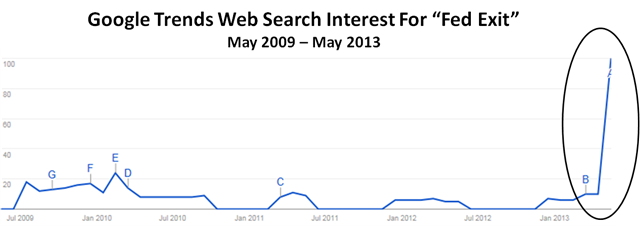
Explaining This Week’s Market Jitters in One Chart

fed exit chart 2

Posted in Uncategorized | Tagged | Comments Off on Explaining This Week’s Market Jitters in One Chart