Why the Debt Ceiling Debate Should Be Different This Time

gigantor

Same political dysfunction. Same blue team indifference to soaring government debt. Same hypocrisy from those on the red team who helped set debt on its upward trajectory. Same lack of any serious effort to tackle the most important issue – the unsustainable paths of our major entitlement programs.

But there is one difference.

Continue reading

Posted in Uncategorized | Tagged , , , , , , , , , , , , , | Comments Off on Why the Debt Ceiling Debate Should Be Different This Time

Breaking Bad News from the Fed’s Z1: Expansions Tend to Explode Near Current Leverage Multiples

breaking bad 2

In an earlier article, I argued that the S&P 500 (SPY) is more expensive than you might think if you only compared prices to trailing earnings.  I recommended a different approach that suggests today’s valuation is similar to that of 1997 or 2006, a few years ahead of the respective bubble peaks of 2000 and 2007.

But what about credit markets?

Continue reading

Posted in Uncategorized | Tagged , , , , , , , , , , , , , , , , , , , , , , , , , | 5 Comments

Detroit’s Bankruptcy Postmortem: The Worms Keep Slithering Out

detroit photo 2

You may have seen recent revelations that Detroit routinely raided its pension funds to award extra cash – including bonuses dubbed “the 13th check” – to both retirees and active employees. These payments were far in excess of the city’s negotiated obligations and hidden from both the public and Detroit’s bond investors.

Continue reading

Posted in Uncategorized | Tagged , , , , | 1 Comment

One Pre-FOMC Link That Seems To Explain Everything

I was glad to hear Stanley Druckenmiller dismiss the relevance of Fed transparency in a CNBC interview last week. As I wrote in my last post, the hullabaloo over the Fed’s communications doesn’t rank high on my list of concerns. When I hear policymakers talk about transparency, I wonder:

Continue reading

Posted in Uncategorized | Tagged , , , , , , | Comments Off on One Pre-FOMC Link That Seems To Explain Everything

Two Post-FOMC Charts That Seem To Explain, Well, Nothing

Or maybe they sum up the last five months of Fedspeak? I couldn’t decide which.

Continue reading

Posted in Uncategorized | Tagged , , , , | Comments Off on Two Post-FOMC Charts That Seem To Explain, Well, Nothing

Cheeburger Cheeburger (No Coke. Pepsi.): Rick Santelli presents CYNICONOMICS debt projections

Earlier this week, we followed up the CBO’s publication of its 2013 Long-Term Budget Outlook with a chart that we believe should have been included.

But what would Rick Santelli say?

Only Rick would think to mix our debt projections with cheeseburgers and a magnifying glass. Here’s his entertaining take on our chart:

Continue reading

Posted in Uncategorized | Tagged , , , , , , | 1 Comment

Technical Notes for ‘63 High Government Debt Episodes’

This is an appendix for my earlier post, “63 High Government Debt Episodes and What They Tell Us about Our Options Today.”   It contains a summary of credit events that occurred during the debt battles listed in the main article.  I’ll also explain the calculations behind America’s current 105% debt-to-GDP ratio.

Continue reading

Posted in Uncategorized | Comments Off on Technical Notes for ‘63 High Government Debt Episodes’

63 High Government Debt Episodes and What They Tell Us about Our Options Today

Do you wonder what to make of America’s soaring government debt and what it means for the future? Or, if you already have it figured out, are you interested in research that might challenge your position?

Either way, you might like to see the results of this exercise:

  1. Take each historic instance of government borrowing rising above America’s current debt of 105% of GDP.
  2. Eliminate those instances in which creditors received a lower return than originally promised, due to defaults, bond conversions, service moratoriums and/or debt cancellations.
  3. Of the remaining instances, consider whether and how the debt-to-GDP ratio was reduced.

In other words, let’s see what history tells us about today’s debt levels and what comes next. You may find the answer surprising.

Continue reading

Posted in Uncategorized | Tagged , , , , , , , , , , , , , , , | 1 Comment

The Surest Way to Spot Trouble: When Even the CBO Says There’s a Problem

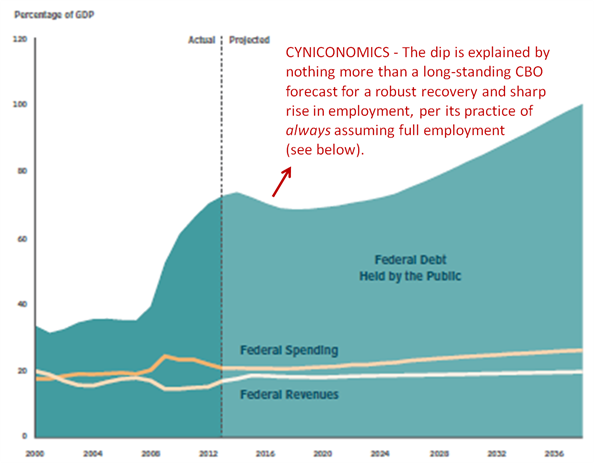
The Congressional Budget Office (CBO) released its 2013 Long-Term Budget Outlook this morning, and its government debt projections are dismal.

As shown below, the so-called “baseline scenario” that adorns the report’s cover is pointed upwards for the first time, owing to January’s tax law changes. And the trajectory is steeper than in the projections I released in July.
cbo cover chart

But the CBO’s featured chart only tells a small part of the story. The baseline scenario happens to be bogus. Even as it shows our addiction to debt worsening, it doesn’t do justice to the severity of that addiction.

In an ideal world, the CBO would highlight a more meaningful chart, one that matches up better with economic, demographic and political realities.  Of course, there are statutes that restrict the content of CBO materials, but these can and should be changed. They, too, are bogus.

In any case, I’ve updated an alternative chart that we first put forward in August:

Continue reading

Posted in Uncategorized | Tagged , , , , , , , , , | 2 Comments

In Case You Blinked and Missed It, Ron Paul Seems To Have Gone Mainstream

I mostly wanted to say we haven’t forgotten about the blog – I’ve been doing research for future posts – but in the meantime I’ll share some links on Syria that I saved over the past few weeks.  (H/t Zero Hedge for many of the pointers.)

Continue reading

Posted in Uncategorized | Comments Off on In Case You Blinked and Missed It, Ron Paul Seems To Have Gone Mainstream